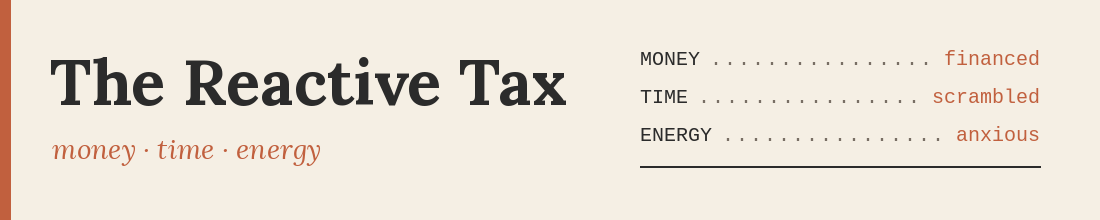
Most people think they have a time problem. I think most of us have a reactive problem, and it charges us in all three currencies at once. I’ve written about the two currencies you spend every day, time and money. Being reactive adds a third: energy.
How the tax gets collected
Start with money, because it’s the easiest to see. The classic financial independence advice is to build an emergency fund, and it’s classic for a reason. In the Federal Reserve’s latest household survey, 63 percent of adults said they’d cover a surprise $400 bill with cash, savings or a card paid off at the next statement. That number hasn’t moved in three years. Twelve percent of adults said they couldn’t cover the bill at all.
Without that buffer, every surprise turns into a reactive decision. You finance something small because you have to. You make large extra payments you didn’t need to make. You pay a premium for not having been ready. Not having a reserve is expensive.
Then there’s time, which in my house showed up at dinner. Before I had a meal planner, meal planning just didn’t happen. I’d buy the staples plus random interesting things, and find out what was missing when the kids were already hungry. That scramble happened a few times a week. I didn’t order takeout. I’d find something else, or just make sure it worked. What it cost wasn’t really the minutes. It was the quality of the food, and the kids weren’t part of it. They were off doing their own thing.
Then there’s energy. Reactivity creates anxiety and a feeling of being unprepared, and you carry that into the hours that are supposed to be yours. An hour isn’t a fixed unit, and the reactive ones are the most expensive kind.
Proactive is the investment
Here’s the arithmetic. Setting up the planner took me easily under an hour. It needs some adjustment along the way, like any system. A scramble a few times a week is somewhere between 100 and 150 dinners a year. Even if the plan only rescues most of them, that’s under an hour of setup against something like a hundred nights that went from making do to an actual meal.
Now an AI meal planner builds the week around what we like, how long I want to spend cooking and what’s in the house. I use it more as a guide, to help me when I don’t want to figure it out. I still pick up the interesting vegetables myself, and now also the ingredients that make it a complete meal. The curiosity stays, the gaps go away. Planning once means I’m not half-thinking about dinner all week. (Build Something That Doesn’t Need You made the same case for a business.)
What the return looks like
The peanut sauce didn’t work. It was a Thai peanut dish, and maybe I was missing an ingredient or had to substitute something. Or it just wasn’t flavors I was used to playing with.
It didn’t matter. My son loves chopping, and that night it was purple cabbage. His younger sister got into it too. They chopped it quite finely, maybe more than the recipe called for, and he kept chopping well past what we needed. When he gets focused in on something, he wants to keep going, and I’m happy to encourage that. We had jokes, and we were laughing and talking and cooking together for 45 minutes. The fact that I didn’t know how to cook everything, and there was a set recipe plan, got a lot more buy-in from him. Teamwork is the word I’d use, and I think he’d call it that too.
The plan didn’t fix the sauce. What it gave us was the 45 minutes.
Reacting by choice
None of this means planning everything. Reacting sometimes opens up opportunities. On a road trip through Spain we kept our options loose, and when Barcelona got too expensive we took an overnight ferry to Mallorca instead (I wrote about it in The Double-Hedged Sword). That was a reaction, and it worked out. But once we’d decided, we booked the hotel ahead. There was planning underneath it.
That’s the line. Reacting by default is the tax. Reacting by choice is what the planning pays for. It’s the same reason I can improvise on the piano, in a minor or major key depending on the mood. You can improvise because you know the keys.
It works at dinner too. Some nights the plan calls for something complicated and I’m not up for it, so I keep something easy as a fallback. One night that was salmon, rice already in the rice cooker and a quick vegetable, which skipped thirty to forty minutes of prep. I threw the fish on the barbecue, turned it a couple of times, and went back to play cards with the kids while it cooked itself.
A plan is meant as a guide, not something you have to follow. It points you in the right direction and lights the way.
Where to start
Pick the one place you’re paying the reactive tax most often: the missing buffer, the weeknight scramble, the thing you keep remembering at the last minute. Spend one hour setting it up once. Then watch where the hours you get back go.
Next week, before the Thanksgiving rush: A Budget Is a Confession on Tuesday, then Traveling Lite on Friday, on why the more you pack, the fewer options you have.
If a friend forwarded you this, Breaking Free is two short letters a week about money, time, and getting off autopilot. Subscribe and you’ll never miss the pair.
Reply and tell me: Where are you paying the reactive tax right now, in money, time or energy?
— Ashleigh